Closer to the stories
that defined style.

Introduction
In Romanian fashion, the mid-19th century marked a break from the Phanariot style and a shift toward Western European trends. And women, bold and eager for something new, were the first to take that step. So by around 1850, corsets, velvet hats, capes and crinolines were staples of their wardrobes. Ironically dubbed a “cage” in Paris, in Bucharest the crinoline was given a weighty name - malacov -inspired by the fortress of Sevastopol, which had been captured with great difficulty during the Crimean War.
From one decade to the next, the architecture of the skirt evolved, so that by 1870 the turnura appeared, and the crinoline transformed into the crinolinetă. Sumptuously decorated hats, parasols with precious details and expensive jewelry dictated fashion in Bucharest, which was strongly influenced by French and Viennese styles. Around 1890, the turnura faded from the scene, and oversized puffed sleeves were in vogue. The hourglass-figured woman defined the image of the era.
The late 19th and early 20th centuries are known as “la Belle Epoque,” a period of great artistic effervescence in which fashion played a prominent role: plunging necklines, plenty of lace, long dresses, tightly corseted waists, elaborate hats, intricate hairstyles and refined accessories. Perfume became a must-have luxury item and the first beauty salons appeared in the United States. Women followed the secret codes of seduction and submitted to the tyranny of fashion.
Things would not remain under the influence of romanticism for long, and with the outbreak of World War I, women’s fashion surprised everyone with unprecedented shifts in style: corsets became a thing of the past, the waistline of dresses began to drop and hems began to rise.
While dresses had reached the ankles by 1910, by 1919 they were already falling to mid-calf. After 1920, the hem began to rise, ever more suggestively, toward the knee.
For the first time, the opulence of the bust lost its importance, ushering in an era of women with more discreet figures. And, paradoxically, through the door of disaster opened by the war, the long-awaited freedom of women tiptoed in, along with the image of death. Girls began doing things that had been forbidden for so long: cutting their hair, wearing shorter dresses and smoking. They were called “flappers,” but they didn’t mind since they had finally managed to gain their independence. It was the beginning of the Roaring Twenties; the world was dancing the Charleston and silent film stars inspired a feminine ideal. In the art world, the avant-garde was in full swing and the eclecticism of Art Deco sparked the imagination of both women and fashion designers alike.
The female silhouette is no longer “S”-shaped but rather “tubular.” Designers’ innovations are also evident in the materials, which are ingeniously decorated with beads, feathers, pearls and embroidery in abstract patterns inspired by painting and architecture. The most important designers of the early 20th century were Mariano Fortuny and Paul Poiret; the latter applied his own theory regarding “the liberation of the woman’s body from constraints” through his creations in the field of women’s lingerie. In the 1920s, the leading names in fashion were Jean Patou and Coco Chanel; the latter launched innovative designs in 1913 made of jersey, a fabric previously considered inferior and used only for lingerie.
Exhibition Curator: Iulia Gornean
Chapter 1
The 19th Century and the Break from the Phanariot Style
In the second half of the 19th century, Romanian fashion definitively abandoned the Phanariot style in favor of Western European influences. By around 1850, the Bucharest wardrobe included the corset, velvet capes and the crinoline - known in Bucharest as “malacov,” after the famous fortress in Sevastopol. On the Mogoșoaia Bridge (later Calea Victoriei), young ladies proudly displayed these enormous skirts, despite the dust and mud of the era.
The architecture of clothing changed rapidly: the crinoline gave way to the turnure in the 1870s, and around 1890, oversized puffed sleeves appeared, cementing the hourglass figure - a look strongly influenced by the salons of Paris and Vienna.
Chapter 2
La Belle Époque and the Muses of Little Paris
The late 19th and early 20th centuries brought the effervescence of “La Belle Époque.”
It was the era of plunging necklines, delicate lace, waists cinched by tyrannical corsets and monumental hats. Perfume became a must-have luxury. In this Bucharest, transformed into “Little Paris,” the high society ordered their wardrobes directly from France, while local muses set the standards of refinement.
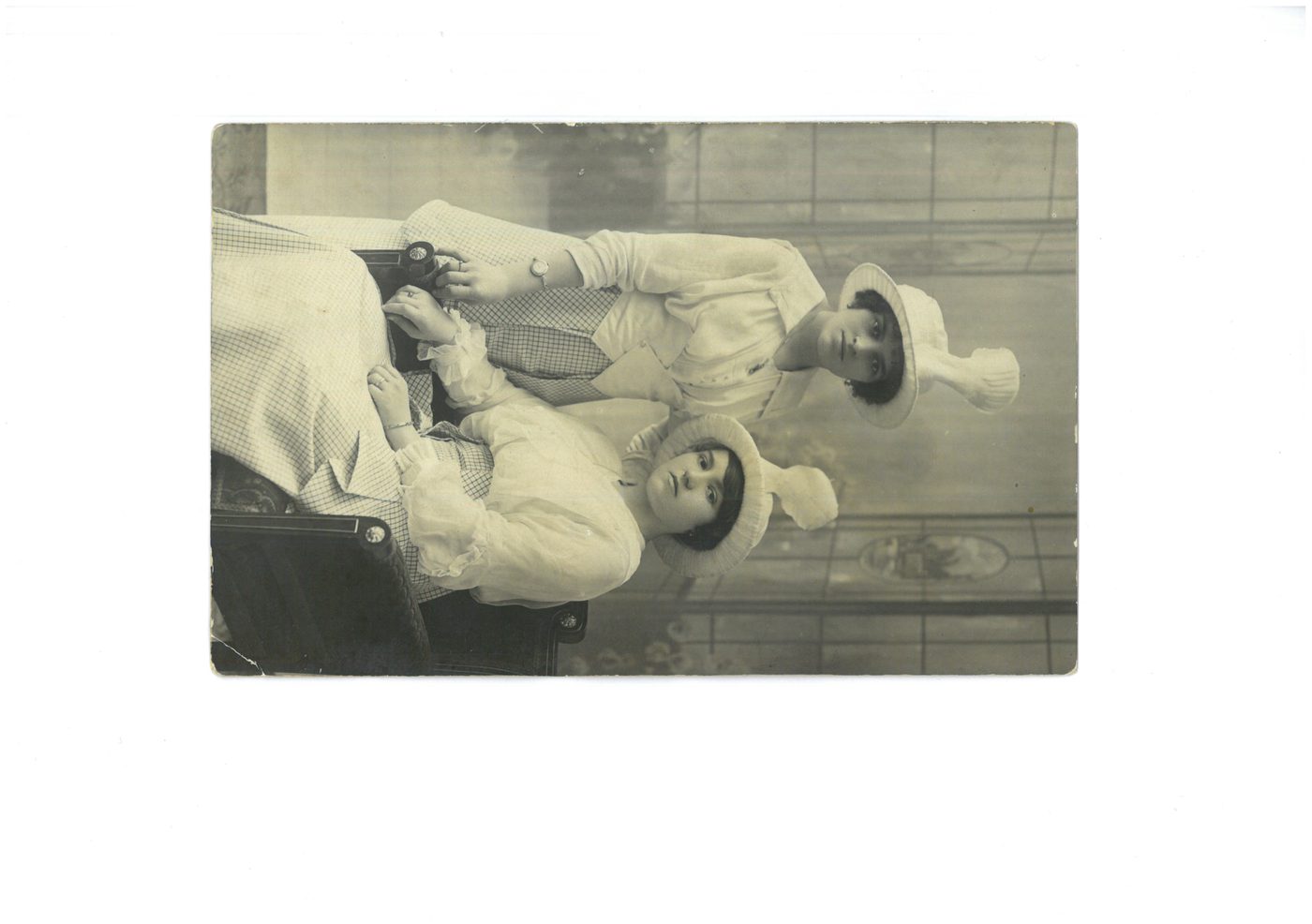
Maria Mihăescu, who went down in history as “Mița the Cyclist,” astonished the capital by wearing pants while riding a bicycle, as well as extravagant corsets brought from Paris.
Alongside her, the poet Elena Văcărescu softens the austerity of the era’s clothing with an extremely chic intellectual grace.
The photograph taken at the C. Barash studio on 28 Calea Victoriei captures the influence of World War I on women’s fashion in Bucharest, marked by a shift toward more practical clothing, featuring structured, military-inspired vests and loose skirts.
The stiff studio hats mimic the shape of period caps but are accessorized with long, white feathers - a detail of urban elegance preserved from the Belle Époque.
Chapter 3
The 1920s: Marioara Voiculescu and the “Flappers” Revolution
With the outbreak of World War I, romanticism faded, and women’s fashion underwent an unprecedented transformation: corsets became a thing of the past, the waistline dropped and hemlines boldly rose to the knee. The tube silhouette emerged, and the emphasis on a voluptuous bust gave way to a preference for women with more understated figures.
Young women cut their hair short (à la garçonne) and smoke in public. They are called flappers. In Bucharest, this wave of emancipation is led by the great idols of the stage and screen. Marioara Voiculescu, the “Marshal of Romanian Theater” and a pioneer of silent film, became the very embodiment of a diva: with a magnetic presence, she brought a dramatic elegance to Bucharest’s salons, setting the tone for avant-garde modernity.
At the same time, Princess Martha Bibescu, a loyal client and friend of Coco Chanel, proudly wore the new jersey creations at dinners at Mogoșoaia Palace, while actress Jany Holt captivated Paris with her hypnotic gaze and rebellious style, characteristic of the Jazz Age.
Chapter 4
Marioara Voiculescu
Marioara Voiculescu was the first woman in Romania to lead both a theater company and a film company, as well as the country’s first female film director. For the women of interwar Bucharest, she was, above all, a style icon: a woman of considerable wealth, she traveled frequently to Paris, London and Vienna, wore the finest jewelry and furs, and was a regular at fashion houses and luxury auctions and her company’s costumes were carefully selected according to the latest Parisian fashions, thereby enhancing the quality of the performances.
Today, almost no one knows anything about her - an injustice that the Hearth Association and the Kerim House are trying to rectify through a restoration project based on her personal archive.
Chapter 5
Magazines and Fashion
Fashion spread not only through shop windows but also through the power of images. From European engravings brought in by carriage to interwar magazines, the press served as a “mirror of desires” and a rigorous guide that shaped the tastes and behavior of women in Bucharest.
At the beginning of the 19th century, Western trends found their way into salons through imported engravings. Gradually, local publications such as "Albina Românească" or "Moda Ilustrată" became style guides. Magazines offered a complete package: images, advertisements, advice and concrete patterns for seamstresses, as well as practical tips and strict rules on how to be an impeccable presence in society.
During the interwar period, everything accelerated. The magazine became a much more dynamic “style teacher.” Thanks to cinema, photography and store windows, styles from Paris or Hollywood were instantly adopted, promoting not just clothing, but an entire modern and active lifestyle.
Elegance has always come with strict rules. When it veered into excess - from the enormous volumes of crinolines or hats to deadly dyes (the famous arsenic green) - society reacted instantly. The press immediately called out these exaggerations through satire, jokes and witty caricatures.
Chapter 6
Queen Marie: An International Icon and a Unique Fashion Style
Queen Marie transcended the boundaries of an ordinary sovereign, becoming a legendary figure on the world stage. Her intelligence, beauty and courage made her a magnetic presence for the international press in Europe and the United States. Her visits to Paris, and especially her historic 1926 tour of America, were followed with bated breath by journalists, who consistently described her as the absolute standard of refinement and cosmopolitan elegance.
Her most spectacular contribution was revolutionizing the way the Romanian folk costume was viewed. At a time when the Bucharest aristocracy viewed peasant clothing with reluctance and preferred exclusively Parisian fashion, Queen Marie had the artistic courage and patriotism to bring the ia, the fota, the marama, and the suman directly to the Royal Court and into the grand diplomatic salons.
Photographs of her wearing traditional costumes with regal pride circulated around the world, bestowing a princely status upon the “cămășii cu altiță” and transforming it into a symbol of national identity.
Today, fashion history officially recognizes her for establishing a unique sartorial style through the ingenious fusion of the Byzantine splendor of her jewelry and tiaras, the fluid lines of the Art Nouveau movement, the practical modernism of the interwar period and, of course, the lavish reinterpretation of Romanian ethnic motifs.
Through this distinctive stylistic formula, she demonstrated that tradition does not belong solely to the past but can be avant-garde, leaving behind an unmistakable regal aesthetic that continues to inspire designers today.